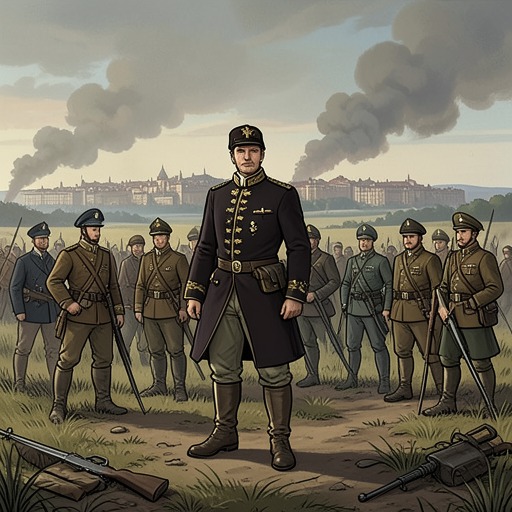
Angolan Civil War period (1975–2000)
Another Day of LifeThe Angolan Civil War period (1975–2000) marks the passage from independence into a prolonged conflict that outlasted the departure of foreign forces and repeatedly exposed the gap between official confidence and the fragile means of survival at the front. The fighting was shaped not only by rival armies but by ammunition, fuel, transport, communication, and the country’s oil and diamonds: resources that could finance the war as readily as they could define what each side sought to control.
Independence and the counteroffensive
On 11 November 1975, the People’s Republic of Angola was proclaimed, with Agostinho Neto as its first president. The new republic’s declared program promised a people’s democracy, state ownership of principal natural resources and economic elements, rights to employment and education, and a policy of positive neutrality. Yet independence arrived while armed forces were still contesting control of the country. In Luanda, the proclamation was followed by celebration, but the city’s northern front had been quiet rather than secure; the political change did not itself end the military threat.
In November, the MPLA army began a counteroffensive supported by units of the Cuban Army. During December and January, the armies of the FNLA and UNITA were destroyed. This reversal followed a period in which accounts of imminent enemy advances and the condition of the fronts had become difficult to reconcile. Leaflets dropped over Luanda in September claimed that Holden Roberto’s army was outside the capital and urged violence against supposed foreign commanders of MPLA units. Later, radio communiqués read by Comandante Ju-Ju could sound most triumphant when events were going badly: when the situation was favorable, they were brief, but worsening conditions brought longer announcements, more self-praise, and more denunciations of the enemy. In the capital, the length of a broadcast could itself become an indirect sign of trouble at the front.
The material limits of the front
The fighting described across the period was constrained by shortages as much as by plans. After a battle, Comandante Ndozi’s wounded could remain in a truck because its driver was waiting for gasoline; there was no doctor at the front, and a shortage of ammunition threatened the unit’s ability to hold the town. Ndozi’s soldiers were inexperienced, and their firing could expend large quantities of cartridges without hitting the enemy. In one reported attack, the opposing force withdrew after the opening volley, leaving Ndozi’s men to enter their objective with no cartridges remaining. The incident captures a recurring imbalance between the noise of combat and the equipment needed to continue it.
Distance made those shortages more dangerous. On the southern front, Comandante Farrusco’s unit numbered 120 men and was the only unit across a region described as one-third the size of Poland. The road was its sole route through a vast, sparsely inhabited area; retreat on foot was impractical, and there was not enough transport to move the whole unit. Elsewhere, a convoy attempting to reach a unit in Pereira d’Eça faced a 450-kilometre road journey through territory where previous trucks had been lost in ambushes. A burned convoy and the absence of water away from the road narrowed the choices further: the road offered passage but exposure, while leaving it meant risking death from thirst.
Air transport partially bridged this isolation. Ruiz, the pilot of the only plane the MPLA had in Luanda, flew an old, damaged DC-3 between the capital, Brazzaville, and besieged towns. He carried ammunition and flour to cut-off forces and brought seriously wounded people back to Luanda. With no reliable air-control system, he might not know who held an airport until he flew over it; enemy fire could force him to turn back. The aircraft’s motors, tires, and patched structure made each flight precarious, while a motor failure could leave towns without supplies and wounded people without evacuation. In a country where roads and communications could not reliably connect the fronts, a single aging plane bore an outsized share of the work of keeping them linked.
Reports, rumor, and morale
Information was another contested wartime resource. In Luanda, anonymous leaflets announced an approaching FNLA army and identified Russians, Hungarians, and Poles as alleged causes of the war. The narrator notes that in September he was the only person from Eastern Europe in all Angola, making the appeal to target supposed foreign commanders especially threatening to him. With no functioning authorities in the city, gangs associated with PIDE could move about with impunity and make inquiries at the hotel. Rumor and propaganda did not merely describe danger; they made the identity of the enemy uncertain and turned ordinary knocks at a door into potential warnings.
Radio communiqués offered a competing account. Comandante Ju-Ju read the MPLA’s daily war report at eight each evening, and his emphatic accounts could present losses as heroic resistance and victories as decisive. Later, when half the country was in enemy hands, an especially optimistic communiqué seemed at odds with the situation. The contradiction was politically consequential: reassurance could discourage panic, but if people were told that events were going well while being asked to defend the city, they might lose faith in the appeals themselves. The wartime information environment therefore carried a practical risk. A message intended to maintain resolve could also blunt the urgency needed to act.
A war that outlasted foreign intervention
The counteroffensive did not bring a lasting end to the conflict. The book’s retrospective account identifies 1976–2000 as years in which the war continued, even after Cuban and South African forces had departed. The central government remained engaged for three decades in a rebellion led by Jonas Savimbi, while Angola remained divided and devastated by civil war. The withdrawal of foreign forces changed who remained in the fighting, but did not settle the struggle among Angolans.
The country’s resource wealth helped make the conflict durable. The government had substantial oil deposits, while Jonas Savimbi controlled great diamond mines; revenues from these resources enabled both sides to continue waging war. The account estimates that perhaps a million people had already died and warns that the number of victims would keep growing. Its final return to people encountered during the earlier fighting makes the long duration personal: Diogenes might no longer be alive, Farrusco would be too old for the trenches, and Comandante Ndozi had died after being blown up by a mine. The conflict’s span is thus measured both in political decades and in lives carried forward, lost, or drawn into the next generation.